Thursday, March 27, 2014

“Stand Against Transphobia” Photo-Exhibition Set for the National Library


On March 31, transgender people the world over celebrate International Transgender Day of Visibility (ITDV). Joining these global celebrations in an effort to raise awareness locally, Guyana Trans United (GTU) and the Society Against Sexual Orientation Discrimination (SASOD) will be hosting a week-long “Stand Against Transphobia” Photo- Exhibition. 

The Photo-Exhibition will be launched on the ITDV itself, which is Monday, March 31, 2014, at the National Library’s Conference Room at 11:00 hrs. The exhibition will be housed in the lobby of the National Library from Monday until Saturday, April 5, 2014. Dr. Shanti Singh, Programme Manager at the National AIDS Programme Secretariat of the Ministry of Heath, will cut the ribbon, declaring the photo-exhibition officially open. Outspoken Guyanese trans activist and GTU member, Twinkle, will be the keynote speaker at this event.
Keynote Speaker, Twinkle (Photo Courtesy of Ulelli Verbeke)

SASOD Co-Chair, Ulelli Verbeke, is the photographer and curator behind the photo-exhibition. She has travelled around Georgetown and West Demerara to interview and photograph transgender Guyanese from all walks of life who have consented to participate in this ground-breaking activity. “I was very moved by the openness of these trans folks who shared their stories with me,” Verbeke remarked. “I’m inspired by their bravery and willingness to participate in the project, not knowing how it will be received,” she added.
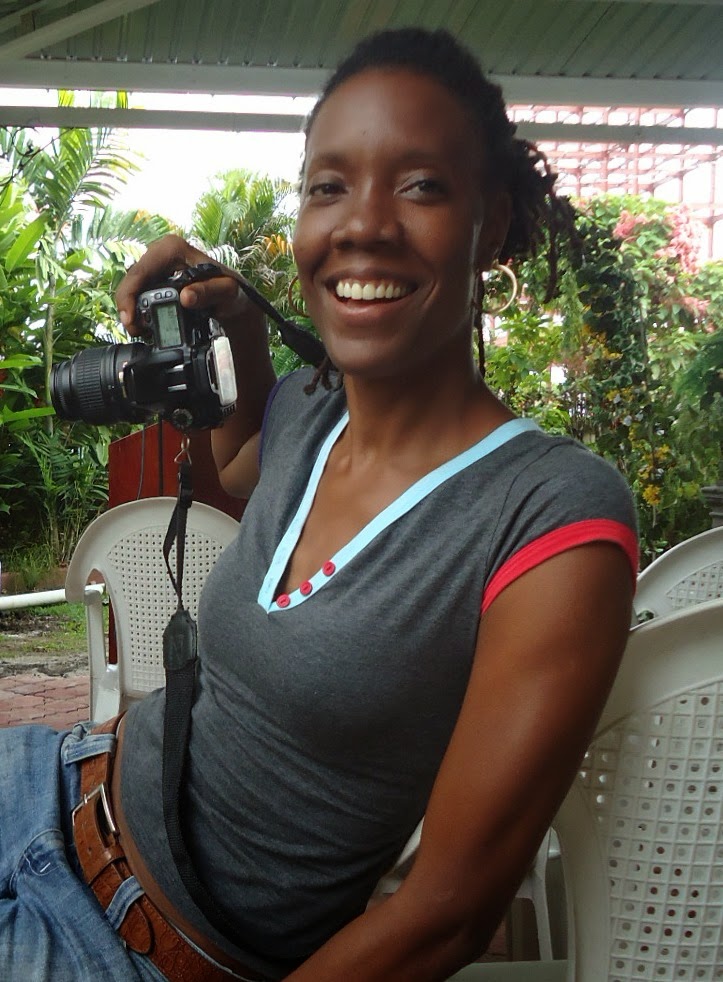
SASOD’s Co-Chair, Ulelli Verbeke (Photo Courtesy of Priscila F. Pascoal)
 
Their participation is particularly courageous in the context of Guyana where the laws criminalise cross-dressing and there have been police crackdowns against working-class transgender women. In a September 2013 decision, Chief Justice (ag.) Ian Chang ruled that cross-dressing in public is only a crime if it is done for “improper purpose.” The learned judge did not clarify what the term “improper purpose” means nor did he indicate what improper purposes gave rise to the February 2009 police crackdown against cross-dressing. SASOD and the four trans litigants are appealing this and other aspects of Chang’s decision. 

Locally, transgender Guyanese are struggling for equality and rights to live freely, without stigma, discrimination and abuse.  The  Guyana Trans United (GTU) and the Society Against Sexual Orientation Discrimination (SASOD) aim to utilize this photo-exhibition to continue to empower transgender Guyanese to “stand against transphobia” by ‘visibilizing’ them in their own images and words.  The groups believe visibility is key to empowerment. 

GTU is a collective of transgender and gender non-conforming Guyanese working to empower trans Guyanese communities to advocate for their human rights and participate as equal citizens in decision-making processes at all levels of Guyanese society. 

SASOD is a local human rights organisation and movement dedicated to achieving equality and justice for all Guyanese, especially those suffering discrimination based on their sexuality, gender, sexual orientation, gender identity and gender expression. 

ITDV is a day to visibly celebrate being transgender. It’s a day to raise awareness of the discrimination faced by transgender individuals and to highlight accomplishments. It is also an important day for allies and stakeholders to show their support for transgender people. The theme is “Stand Against Transphobia” for the first commemoration of ITDV in Guyana. 

The “Stand Against Transphobia” photo-exhibition is being hosted by GTU and SASOD with financial support from Equal Rights Trust (ERT), the Delegation of the European Union to Guyana (EU) and the Joint United Nations Programme on HIV and AIDS (UNAIDS).

public is invited to attend Monday’s launch event and the week’s photo-exhibition. 

    Invitation to the Launch of the “Stand Against Transphobia” Photo-Exhibition

Tuesday, February 18, 2014

Over 300 Strong Walk for Equality to End All Violence in Guyana

Over 300 persons from all walks of life took part in the Walk for Equality on Sunday, February 9, to say “No to violence”. Despite heavy rain at the start of the event, people came from as far away as New Amsterdam, Moraikabai, Linden and Parika. There was an impressive turnout from the Catholic and Anglican churches, youth groups, and members of the diplomatic corps. Participants included His Lordship Bishop Alleyne, OSB, leader of the Alliance For Change, Khemraj Ramjattan, MP, and Stabroek News’ columnist, Iana Seales.


His Excellency Francisco Olguin, Ambassador of Mexico (left), His Lordship Bishop Francis Alleyne, OSB (middle) and Khemraj Ramjattan, MP (right) participating in the Walk for Equality.

The purpose of the walk was to bring people together and to celebrate our common humanity and dignity by saying no to violence. Melinda Janki of the Justice Institute Guyana, and Joel Simpson of the Society Against Sexual Orientation Discrimination (SASOD), led the walkers as they chanted “No More silence! No to Violence!!” with banners and placards.


Melinda Janki (far right) from the Justice Institute Guyana and Joel Simpson (far left) leading the Walk.

At the closing rally at the Parade Ground, Vanda Radzik speaking in an individual capacity gave some stirring remarks about the influences of culture on gender and society. Ms. Radzik is also a Commissioner on the Women and Gender Equality Commission.
Melinda Janki stated, “We have to respect people even if they do things we do not like. We can condemn the behaviour but not the person.”
Melinda Janki called for justice for Colwyn Harding and other victims of police brutality, but she also asked the crowd to remember the police officers who had been killed while on duty.
“Lance Corporal Sherwin Panlitz: shot and killed close to here on Middle Street. Lance Corporal Michael Forde also shot and killed in the same incident. Corporal Romain Cleto: gunned down. We also have to say NO to violence against our police officers.”


Justice Institute Guyana's Melinda Janki making her remarks at the closing rally.

Wintress White, a survivor of gender-based violence and member of Red Thread, read out the names of 29 persons who were killed by their intimate partners in 2013. She referred to Guyana's $35,000. minimum wage as a form of economic violence which often leads to domestic abuse. She reiterated the message on Red Thread's banner, “The first step to ending all violence is to end state violence.” “If we want to end violence, we have to stop beating our children – end corporal punishment now! If we want to the end violence, then police must stop brutalising and raping our youths; our young men and boys, and our women and girls,” White said.


Red Thread's Wintress White speaking at the closing rally.

Also speaking at the rally was Paula Niles, aunt of Wesley Holder, also known as Tiffany – a transgender teen who was murdered in January 2012. Ms. Niles showed photos as she spoke of her undying love for Tiffany. She was followed by Seon Clarke of the Guyana Trans United, also known as Falatama or Angel, who recounted the violence she experienced by the police during the February 2009 crackdown against cross-dressing in Georgetown.
Concluding the speeches was Dr. Philbert London of Archbishop of Beacon Ministries who urged the gathering to say no to violence and yes to love. His charge was one asking persons to be more loving and forgiving towards each other.


Dr. Philbert London, Archbishop of Beacon Ministries, delivering closing remarks

The Walk for Equality is an event of the Guyana Equality Forum (GEF), a group of civil society organisations working for equal rights and justice for all Guyanese. GEF members who marched include Family Awareness Consciousness Togetherness, Guyana Trans United, Red Thread, Guyanese Organisation of Indigenous People, Guyana Sex Work Coalition, Youths For Guyana, Artistes In Direct Support, Justice Institute Guyana, S4 Foundation, Help and Shelter, among others, along with SASOD, which serves as the GEF's secretariat.
                                                                                                                                                                           
           Red Thread and Guyana Trans United banners on display at Parade Ground.

His Excellency Francisco Olguin, Ambassador of Mexico, and Ms. Olguin, Mr Derek Lambe of the Delegation of the European Union to Guyana, and Ms. Lambe, and Ms. Kadija Mousa, Resident Representative of UNDP, were present on the Walk. There were walks in solidarity, including at Hopetown in Berbice, and at Carleton University in Ottawa, Canada.

The GEF thanks everyone who took part in the Walk or supported the event. We thank the musicians for giving us their time and wonderful music. We thank Pegasus Hotel – Guyana, Mr. and Ms. Bernie Fernandes and an anonymous donor for providing water for the walkers. We thank the police officers who took us safely through the city traffic. Special thanks also to the nurses from the Guyana Nurses Association who were on call at the Walk for Equality to provide first-aid assistance, in the event of a medical emergency. Thanks too to Vic Insanally for donating some of the printed banners for this Walk. We also acknowledge with sincere gratitude the support of the Delegation of the European Union to Guyana which enabled the GEF to give participants tee-shirts stating “Equal Rights and Justice for All / No to Violence.”

Wednesday, December 11, 2013

Speech by SASOD's Secretary at Loyola Documentary Film Festival Launch


Loyola Documentary Film Festival 2014
Launch Ceremony, December 11, 2013
Impeccable Banquet Hall
Georgetown, Guyana


Honourable Minister of Culture, Youth and Sport, Dr. Frank Anthony, Head of the Roman Catholic Church in Guyana, Bishop Francis Alleyne, OSB, Father Justin Prabhu, SJ, other members of the Roman Catholic Diocese, special invitees, members of the media, ladies and gentlemen, good morning to you all. I am indeed honoured to speak with you today on this occasion of the launch of the Loyola Documentary Film Festival, organised by CatholicTV. First, I would like to congratulate the Catholic Church in Guyana on this ground-breaking initiative. Our fledgling film-making industry needs these kinds of initiatives to encourage its development.

Documentary film-making is an important genre of film-making as it provides an avenue to share real-life stories through the powerful medium of film. But not only is the contribution of documentaries to film-making good for the art form, it is also an instrumental tool in our work on addressing social, economic and cultural issues in Guyana. I was particularly pleased to see that the objectives of the Loyola Festival include documenting livelihood issues of the rural and urban poor, exposing situations that affect survival and human rights, and advocating with policy makers for changes in policies, and with social leaders for changes in practices. In this regard, documentaries are a invaluable medium in public education to reach people with visual narratives to which they can relate. Documentaries also contribute to the evidence base which decision-makers often need to build the case for policy changes.

In my own experience, documentaries are effective at highlighting issues of the poor and vulnerable who are often forgotten. At the Society Against Sexual Orientation Discrimination (SASOD), we started using video as a form of documentation for human rights violations when the Guyana Police arrested 7 male-to-female transgender persons for cross-dressing over a 48-hour period in February 2009. With a small camcorder, SASOD was able to respond quickly to record the testimonies of these transgender victims who suffered a range of human rights abuses at the hands of the Guyana Police, including denial of their rights to be informed of the reasons for being arrested, not being allowed to phone calls or contact lawyers – these are all basic rights under the Guyana Constitution. Beyond that, they were kept imprisoned over the 72-hour constitutional limit, and mocked and abused by the police who held them in custody. When they were brought before the court, then acting Chief Magistrate – now Judge – Melissa Robertson, told them that they were men – not women – and that they need to “go to church and give their lives to Christ.” This video documentation contributed to SASOD's first documentary, produced 2 years later in May 2011 by local journalist Neil Marks, aptly titled “My Wardrobe, My Right” - which is a 20-minute feature which highlights the life stories of Peaches and Gulliver, 2 of the transgender women who were arrested during the police crackdown. A preview of “My Wardrobe, My Right” is available on the SASOD YouTube channel. Since then, SASOD has produced several other short video documentaries where lesbian, gay, bisexual and transgender (LGBT) Guyanese share their experiences of social stigma, economic disadvantage and exclusion, which make them even more vulnerable to human rights abuses. The fact that same-sex intimacy and cross-dressing are criminalised also makes it difficult for LGBT Guyanese to access equal protection of the law, which is also a protected right in the Guyana constitution. SASOD is also currently working with Neil Marks and Mark Murray to produce another 20-minute feature on the “Double Stigma” faced by sexual and gender minorities living with HIV in Guyana. It is slated for release in January 2014, and hopefully we will be able to submit it to the inaugural Loyola Documentary Film Festival for your consideration. :)

Documentaries allow us to put real names and faces to our work to end poverty and discrimination in Guyana. In addition to the videos on LGBT human rights issues on the SASOD YouTube channel, I want to encourage everyone here to look at another local documentary on YouTube called “Tin City Voices” which boldly depicts the issues affecting the urban poor in the Georgetown's ghettos. The poor and the marginalised can no longer be ignored or made invisible to the general public and our policy makers, as documentary film-making provides us with a powerful tool to reach millions with personal experiences and visual evidence. And with the undeterminable reach of the internet, our audiences need not be confined to local film festivals or national television. If international 'naming and shaming' is what it will take to effect change, then, as social advocates, we also need to embrace these methods to bring about real change for the poor and the powerless who are depending on us to represent them.

Once again, I want to congratulate CathoicTV and the Catholic Church of Guyana for this innovative venture. If I'm not mistaken, I believe this is the first, local documentary film festival in Guyana, so hats off to the Catholic community for blazing a new trail in the local film industry. I also want to encourage the private sector to come on board, and support the industry. Resources are also needed to make good films.

Thank you, and best wishes for a successful festival. I look forward to attending and seeing the new local documentaries on these issues. 


Zenita Nicholson


Secretary, SASOD Board of Trustees 


Thursday, December 05, 2013

Civil Society Experts Urge More Men to Help End Gender-Based Violence


Civil society experts are calling for more men to become involved in the response to the escalating pandemic of gender-based violence in Guyana. The call was made at a film screening and panel discussion hosted by the Guyana Equality Forum (GEF), and its partners, on Monday, November 25, 2013 in observance of the International Day for the Elimination of Violence Against Women.

The film screening and panel discussion, which was held at Moray House in Georgetown, was the kick-off awareness-raising event for the 16 days of activism to end gender-based violence which culminates on December 10, 2013 - Human Rights Day.  Two films were screened to stimulate the panel discussion about gender-based violence. The first, “Audre Lorde - The Berlin Years: 1984 - 1992,”produced and donated by Dr. Dagmar Schultz, chronicles the years the acclaimed black, feminist, lesbian poet and activist, Audre Lorde, spent in Berlin, and her contributions to the Afro-German women's movement and her contributions to the German discourse on racism, xenophobia, antisemitism, classism, and homophobia within the black movement, and the black and white women’s movement. The second film, “Voices of Survivors” is a short documentary produced by Red Thread which shares the heart-wrenching stories of Guyanese women who have suffered domestic violence.

                                                                   Event Flyer

Both films proved very insightful and catalyzed discussions on respecting differences and the influence of religion on the socio-cultural norms which lead to gender-based violence. Much of the discussion centered on how some faith-based organisations perpetuate this violence; and conversely, the role of religious institutions as safe spaces and places of solace for victims of gender-based violence. Rev. Patricia Sheerattan-Bisnauth, Executive Director of GRPA, pointed out that the church is breaking its silence and speaking up against domestic violence.
Also speaking on the panel, Eric Phillips, Executive Director of the African Cultural Development Association (ACDA), lead the call for more men to be involved in the movement to end gender-based violence but also contended that women's leadership, especially political leadership, is very important to this issue. 

Mr. Eric Phillips of ACDA speaking at the panel discussion

The other panelists were Karen De Souza from Red Thread, and Daunta Radzik representing Help and Shelter. They all noted that the level of violence within the family is alarming and that more has to be done to discourage others from being passive onlookers whenever abuse is occurring. Karen De Souza pointed out that  religious organisations need to be part of a comprehensive national plan to end gender-based violence and that the message has to come from them that “as important as the family is, it cannot be erected as more important than the safety of the women and children of the family.” Danuta Radzik commented that violence exists because of inequalities in relationships between men and women and that, to some degree, it is perpetuated by fear. “The fears and prejudices that suppress women are similar in nature to those that lead to discrimination against homosexuals, bisexuals and transgenders,” Radzik added. 


(From left to right) Rev. Patricia Sheerattan-Bisnauth of GRPA and Ms. Karen De Souza of Red Thread participating in the panel discussion

Other recommendations from the panel and the audience include the need to address violence against children, and expanding the Health and Family Life Education curriculum to include topics about sexuality and violence. There was also a call for the strengthening of institutional frameworks created to protect victims of  gender-based violence, and for material resources to be provided to support persons to leave abusive relationships. The discussions were moderated by SASOD's Co-Chair, Joel Simpson. 


(From left to right) GRPA's Rev. Patricia Sherrattan-Bisnauth, SASOD's Joel Simpson and Help and Shelter's Danuta Radzik after the panel discussion

Partnering with the GEF to host the event were GRPA, Red Thread, Help and Shelter, The Mothers' Union of the Anglican Church, Guyana Rainbow Foundation and the Society Against Sexual Orientation Discrimination (SASOD). The GEF is a network of civil society groups working cohesively to achieve equality and realise human rights for all Guyanese. The GEF is currently chaired by Red Thread while SASOD serves as its administrative secretariat. The event was funded by the Astraea Lesbian Foundation for Justice through SASOD.

Please see more photos on our website - http://sasod.org.gy/photos-idevaw-film-screening-and-panel-discussion 

Wednesday, December 04, 2013

GCCI to Launch Comprehensive Anti-Discrimination Workplace Policy

Press Release from the Georgetown Chamber of Commerce and Industry
November 15, 2013
(Georgetown, Guyana) The Georgetown Chamber of Commerce and Industry (GCCI) is partnering with the Society Against Sexual Orientation Discrimination (SASOD) to develop and launch a comprehensive anti-discrimination workplace policy which includes sexual orientation and gender identity as prohibited grounds. GCCI President, Mr. Clinton Urling, made this announcement in his opening remarks at a seminar, on “Business and Human Rights: Tackling Workplace Discrimination” on Wednesday, November 13, 2013, at Hotel Pegasus Guyana, hosted by GCCI in collaboration with SASOD.
The seminar which targeted sector-leading commercial entities who are members of the GCCI and its allied agencies, sought to sensitize managers and business owners on issues relating to stigma, discrimination and human rights violations based on sexual orientation and gender identity in the workplace, with the view of enhancing their understanding of the issues by discussing how they can contribute to promoting equality in the workplace, and nationwide in Guyana. Moreover, the seminar discussed the business case for respecting human rights, demonstrating how work environments which include and respect sexual and gender diversity enhance business efficiency and foster good psycho-social health of their employees; all of which increases their productivity. 


 Some of the participants at the GCCI/SASOD seminar at the Hotel Pegasus Guyana.
In his opening remarks, Mr. Urling first lauded SASOD for their stellar advocacy work over the past ten years which has “certainly informed our citizenry, changed perceptions and attitudes of bigotry and intolerance and have resulted in actions to end discrimination based on sexual orientation and gender identity by policy-makers and other stakeholders.” He further stated that now it is the private sector’s turn to get involved, as such he urged his colleagues to grasp as much as possible from the seminar and to return to their various entities and start their own internal discussions on developing, or in some cases, strengthening company policies, to eliminate all forms of discrimination, including sexual orientation and gender identity. Mr. Urling also remarked on how urgent it is for our own policy-makers in Guyana to advance legislation that would end workers discrimination and ensure that employers cannot fire or refuse to hire someone based on his or her sexual orientation or gender identity. “It will not be an easy battle but one in which we have to advance to ensure that the fundamental human rights of all Guyanese are protected. In all these situations it took adaptive changes to effect this. The citizens and people were part of the problem and changing their attitudes and beliefs were key to enacting the necessary legislation. That is the important role of SASOD and what this seminar seeks to do,” Mr. Urling added. 


 GCCI President, Mr. Clinton Urling, makes opening remarks. 
The presenters at the seminar were Zenita Nicholson, SASOD Secretary, who focused on the business efficacy for respecting human rights in the workplace; and Joel Simpson, SASOD Co-Chair, who deliberated on the current legal framework as it relates to human rights and workplace equality in Guyana. Facilitated by communications specialist and business executive, Ms. Catherine Hughes, M.P., the seminar discussed key issues, including the importance of workplace polices that include protection from discrimination for lesbian, gay, bisexual and transgender (LGBT) employees, how managers deal with homophobic and transphobic discrimination in the workplace; and externally, how businesses treat their LGBT customers and clients. In closing the plenary discussions, Ms. Hughes, M.P., urged the participants to utilize the resources from the seminar to advance workplace equality in their entities. 


 SASOD Co-Chair, Mr. Joel Simpson, presents on Human Rights and Workplace Equality in Guyana.
Another moving segment of the seminar was the first screening of “Sade’ Story,” a new video produced by SASOD in which Guyanese transgender fashion designer, Sade Richardson, candidly shares how her right to work and other basic rights are inhibited by the everyday transphobic discrimination she faces.
After the video screening, Ms. Hughes, M.P., reminded participants that SASOD – in its mission to promote equality and justice for all Guyanese and eliminate discrimination based on sexuality, gender, sexual orientation, gender identity and gender expression in Guyana – stands ready and willing to support organisations to develop comprehensive anti-discrimination policies and promote workplace equality.


 Seminar chair, Ms. Catherine Hughes, M.P., facilitates a plenary session.
GCCI Executive Director, Ms. Marissa Lowden, closed the seminar, thanking the participants, the organizing team and the donors who made the event possible. The seminar was supported by the Delegation of the European Union to Guyana, through the European Instrument for Democracy and Human Rights, Equal Rights Trust and the Astraea Lesbian Foundation for Justice. 


GCCI Executive Director, Ms. Marissa Lowden, delivers the vote of thanks at the seminar.
 
---
ENDS

Related Web-Links:
“Sade’s Story” on Vimeo: http://vimeo.com/envisioning/sasodsade